“The results speak for themselves – Thanks to Mr. Kageleiry’s advocacy I was exonerated of the allegations against me. Pete was well prepared and he did a great job convincing the board that I had not committed any misconduct.” – from a former client
What is a Military Board of Inquiry or a Show Cause Board?
A separation proceeding involving an officer employs a Board of Inquiry. The Navy refers to a Board of Inquiry as a Show Cause board for Navy Officers. The military owes the officer due process.
The military must inform the officer of the reasons for the intended separation. Officers with six or more years of commissioned service have the right to present their defense at a Board of Inquiry.
During the board hearing, the officer can present evidence against the reasons for the separation action. The officer can also show proof of good military character, duty performance, and service to the nation. The officer should choose an experienced lawyer for the board of inquiry. This lawyer can help fight for the officer’s career.
Attorney Experience Matters for officers facing admin separation
The Board of Inquiry has three members. All of them are higher in rank than the respondent. The senior member is the board president.
Usually, the board members have many years of experience serving the nation. The board members are highly committed to making the correct decision.
An experienced board of inquiry lawyer knows how to communicate clearly with the board members. If the service member does not hire a skilled show cause lawyer, the board members may have more military experience. This could put the military counsel or the government lawyer arguing for discharge at a disadvantage.
An experienced lawyer can influence the outcome of the show cause board. Click here to see sample results for some of Mr. Kageleiry’s clients. These clients fought back against unfair administrative separation.

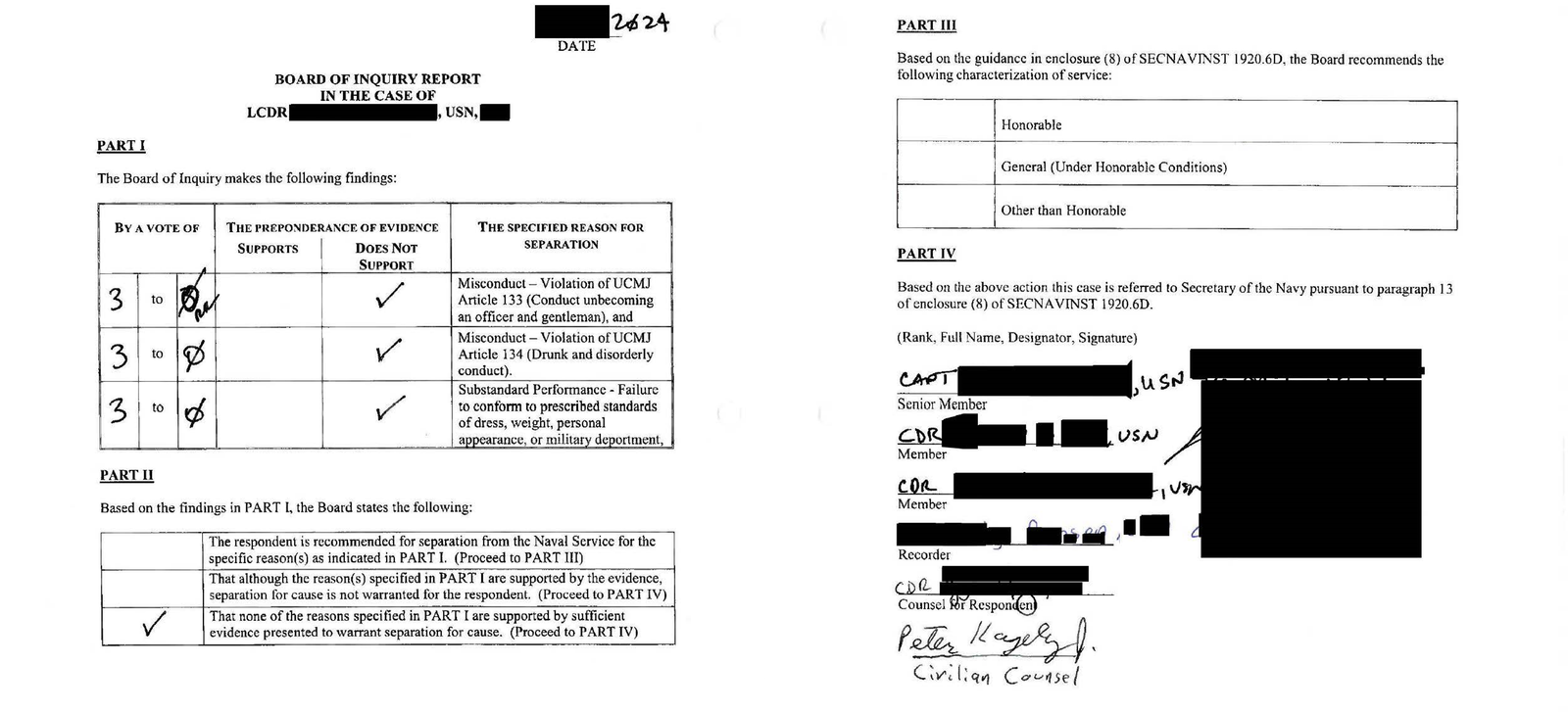
A client’s successful result at a Show Cause board
What is the the Board of Inquiry or Show Cause Board Process for Officers?
The separation action usually follows an adverse administrative action. This can be a formal reprimand or punishment under Article 15 of the Uniform Code of Military Justice. The military will direct the officer to “Show Cause” before a board of inquiry. During the BoI, the officer must justify why they should remain in the service.
The notice will list the reasons for separation and the type of military discharge the officer might receive. A past guilty finding at Captain’s Mast does not ensure a bad result at the separation board hearing. The board members will hear the evidence and arguments from both sides and make their own decisions.
The officer can have a military attorney at the separation board hearing. This hearing is informal, so the rules of evidence do not apply. However, the board must follow certain procedures.
The service member can call witnesses and show documents. The skill level of the attorneys for both sides can affect the hearing’s outcome. An experienced show cause lawyer can greatly impact the board’s outcome.
During the hearing, the board must answer several questions.
- First, does the evidence show that the officer committed misconduct?
- Second, if the officer did commit misconduct, should the board recommend separation from the military?
- Third, if the first two answers are yes, what type of discharge should the officer receive? If the officer can retire, the board may also recommend a retirement pay grade.
The answers to these questions will greatly affect the officer and their family.
Attorney Peter Kageleiry, Jr. will fight for your career and your future.
Contact The Law Office of Peter Kageleiry, Jr. Consultation
I serve service members world-wide. Reach out to my office at +(757) 504-2815 or via our easy-to-use online form to arrange a consultation.
Attorney Peter Kageleiry, Jr., focuses his legal practice exclusively on military court-martial law and related adverse administrative actions.
FAQ: Boards of Inquiry or Show Cause Boards
What is a Military Board of Inquiry (BOI) or Show Cause Board?
A Board of Inquiry (BOI)—referred to as a Show Cause Board in the U.S. Navy—is an administrative military proceeding where a commissioned officer must “show cause” as to why they should be retained in military service following allegations of misconduct, poor performance, or adverse administrative actions.
Who is entitled to a Board of Inquiry hearing before administrative separation?
Commissioned officers with six or more years of active commissioned service have a statutory due process right to present their defense at a Board of Inquiry before the military can involuntarily separate or discharge them.
What decisions does a Board of Inquiry make?
A Board of Inquiry must answer three sequential questions:
Did the evidence establish that the officer committed misconduct or failed to perform duties as alleged?
If misconduct occurred, does it warrant involuntary administrative separation from military service?
If separation is recommended, what characterization of discharge (e.g., Honorable, General Under Honorable Conditions, or Other Than Honorable) should the officer receive? If eligible, the board may also recommend a retirement pay grade.
Who sits on a Military Board of Inquiry?
A Board of Inquiry consists of three senior military officers who are higher in rank than the officer facing separation (the respondent). The senior-most member acts as the board president.
Do strict military rules of evidence apply during a Board of Inquiry?
No. A Board of Inquiry is an informal administrative proceeding, meaning standard Military Rules of Evidence do not strictly apply. However, the board must follow strict procedural guidelines, and officers retain the right to submit documentary evidence, present character witnesses, and cross-examine witnesses.
Can an officer have legal representation at a Board of Inquiry?
Yes. Officers appearing before a Board of Inquiry have the right to be represented by appointed detailed military legal counsel, or they may hire an experienced civilian military defense lawyer at their own expense to fight for their career and retirement benefits.
Does a prior Non-Judicial Punishment (Article 15 / Captain’s Mast) mean an officer will automatically be discharged at a BOI?
No. A prior finding of guilt at an Article 15 or Captain’s Mast does not guarantee discharge at a Board of Inquiry. The independent three-member board considers all new evidence, duty performance records, and character evidence before making an independent determination.
Defending Your Freedom
If you are a soldier, sailor, airman, or Marine facing a military court-martial or
if you are under investigation put Peter Kageleiry to work in your military defense.
Your military career, your service record and your future depend on it.
Contact Us or Call for a consultation: (757) 504-2815