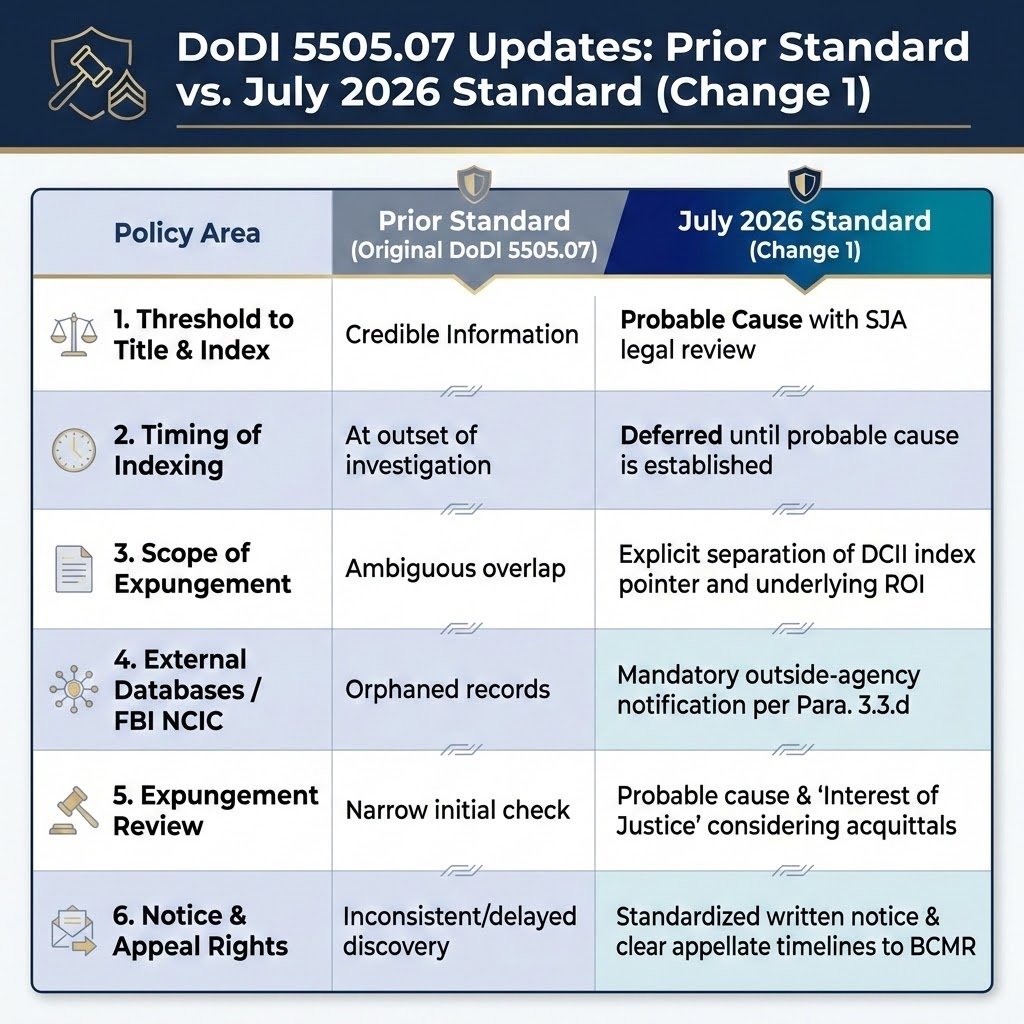
Titled Before July 2026?
How DoDI 5505.07 Change 1 Opens New Doors to Clear Your Military Record
For decades, one of the most unfair traps in military justice has been the titling and indexing system.
Servicemembers were often listed as subjects in a criminal investigation. They were also entered into the Defense Central Index of Investigations (DCII). This could happen based only on an unconfirmed allegation. The standard was so low it was often called a “scintilla of evidence.” Even when charges were dropped, the record could remain. It also stayed if a commander took no action. It could remain even after a full court-martial acquittal. That investigative flag could stay on the servicemember’s name for up to 40 years.
On July 9, 2026, the Department issued DoDI/DoWI 5505.07, Change 1 (Titling and Indexing by DoW Law Enforcement Activities), updates its main indexing rules. It implements key legal requirements from recent National Defense Authorization Acts.
If you or a loved one were titled before July 2026, this regulatory update changes the landscape. While Change 1 limits some administrative shortcuts, it also gives strong new legal leverage to servicemembers and veterans. It helps those who were unfairly labeled under older rules.
Why Servicemembers Titled Before July 2026 Have Strong Leverage Now
- Challenging Legacy Records Against the “Probable Cause” & “Interest of Justice” Standards
Historically, military law enforcement agencies refused to remove old DCII entries if investigators had any “credible information” when they opened the file. This remained true even if later evidence fully exonerated the servicemember.
Under the updated framework in DoDI 5505.07, Change 1 (Paragraph 3.2.a), Expungement officials must decide if probable cause existed, or still exists, to believe the offense occurred.
They must also decide if you committed it. They also decide if removal is warranted in the interest of justice. Furthermore, officials are expressly directed to consider the type, nature, and outcome of any adverse administrative, disciplinary, or judicial action. For some clients, the government indexed them years ago. The government relied on weak, untested claims. Those claims never led to a conviction. If we apply a real probable cause standard to those old files, we find serious problems. These problems show the original indexing decision was flawed.
- A Potential “Second Bite at the Apple” for Prior Denials
Did you previously petitione an agency like AFOSI, CID, CGIS, or NCIS to remove your record and get denied? This change may help. Change 1 implements Section 545 of the FY21 NDAA, as amended by Section 569B of the FY24 NDAA. It updates the same procedures across all components. If your earlier request was denied under old rules, you can ask again. The revised instruction supports a new review under the updated standards.
- Explicit Protection Against Adverse Career Actions
Change 1 strengthens a key legal shield in Paragraph 1.2.c. It states: “Titling and indexing are administrative procedures and will not imply any degree of guilt or innocence.
Judicial or administrative actions will not be taken just because a DoW LEA titling or indexing record exists. A DoW LEA titling or indexing record alone is not enough to take action. In July 2026, the U.S. Court of Appeals for the Armed Forces backed this rule. The court said an agency’s titling decision has no separate legal force. If a board or panel uses a pre-2026 titling entry against you, you can push back. This applies to promotions, command screening, and security clearances. You now have stronger regulatory support to challenge that action. You still need to show there is no independent proof behind the entry.
- Enforcing Outside-Agency Notification (FBI NCIC & Licensing Boards)
One of the biggest frustrations for clients titled before 2026 was winning removal from the military’s DCII database. A client may find an arrest or fingerprint entry still on their FBI Identity History Summary (NCIC/III). This can happen even after they successfully amend their military records. It could also remain active with state licensing boards. While Change 1 separates the DCII index entry from underlying investigative reports and DNA records, Paragraph 3.3.d Preserves and clarifies the originating law enforcement agency’s duty for outside records. This applies when an index entry is corrected or expunged.
It also covers cases where an entry is expunged. By citing Paragraph 3.3.d in your petition, your legal team can require notice. Notice must go to outside recipients. This includes the FBI Criminal Justice Information Services (CJIS) Division. This helps ensure your expungement clears civilian background checks.
Tracking Down Your Record: Knowing Which Agency Titled You
Because Change 1 draws a strict line between the DCII index and the investigative report. It also separates FBI fingerprints and CODIS DNA samples. You need full relief. To win it, send targeted requests to the exact agency that created each file.
How MCIOs Differ from Base Military Police
Understanding the difference between an MCIO and installation police is important when searching for records:
| Feature | MCIO (CID, NCIS, AFOSI, CGIS) | Installation Police (MP, PMO, Security Forces) |
| Role & Equivalent | Plainclothes federal criminal detectives (analogous to the FBI). | Uniformed base patrol and physical security (analogous to local city police). |
| Chain of Command | Independent of local base commanders, agents report through a separate investigative chain of command. This helps prevent command influence. | Reports to the installation commander (typically via the Provost Marshal or Defense Force Commander). |
| Types of Cases | Felony-level UCMJ offenses (sexual assault, major drug distribution, aggravated assault, homicide, larceny, fraud) and counterintelligence. | Misdemeanors, traffic violations, domestic disturbances, barracks incidents, and initial on-scene emergency response. |
| Titling & Indexing | Both MCIOs and installation police can title servicemembers in the DCII. They can also submit fingerprints to the FBI NCIC. MCIOs also have centralized expungement units at their headquarters. | Records are often decentralized across installation Provost Marshal offices or service-level crime record centers. |
Why Precision Matters More After July 2026
While Change 1 gives servicemembers who already have titles stronger arguments for probable cause and the interest of justice. It also narrows the administrative shortcut. Under the new instruction, a standard Section 3 expungement request targets only the DCII index entry. It no longer erases the underlying Report of Investigation. It also does not erase CODIS DNA profiles or decentralized base police blotters.
To truly clear your name today, your attorney must run parallel legal tracks:
- FOIA / Privacy Act Discovery: Obtain the complete Report of Investigation and the Staff Judge Advocate’s original legal review.
- DCII Expungement Petition (DoDI 5505.07, ¶ 3.2.a): Prove lack of probable cause or an interest-of-justice basis to delete your DCII index pointer.
- Outside-Agency Notification (¶ 3.3.d) & NCIC Correction: Compel the agency to notify the FBI to purge or update your arrest and fingerprint record.
- Separate DNA Expungement (DoDI 5505.14): Petition USACIL to remove your DNA profile from CODIS. You can do this if you were not convicted at a General or Special Court-Martial.
- BCMR Escalation (10 U.S.C. § 1552):If the agency will not remove the title block from the investigative report, you can take the next step. If the agency denies DCII relief, you can also take the next step. Petition your service’s Board for Correction of Military Records. This Board has broad legal authority to correct errors and injustices.
Don’t Let a Pre-2026 Investigation Hold Back Your Future
If you were titled years ago—whether by Army CID, NCIS, AFOSI, CGIS, or base Military Police—you do not have to accept a permanent stain on your record. Contact our administrative legal defense team here or call us at +1-757-504-2815 today for a confidential consultation. We will help you find your investigative file. We will build a targeted strategy under the latest DoD rules. Our goal is to clear your record.