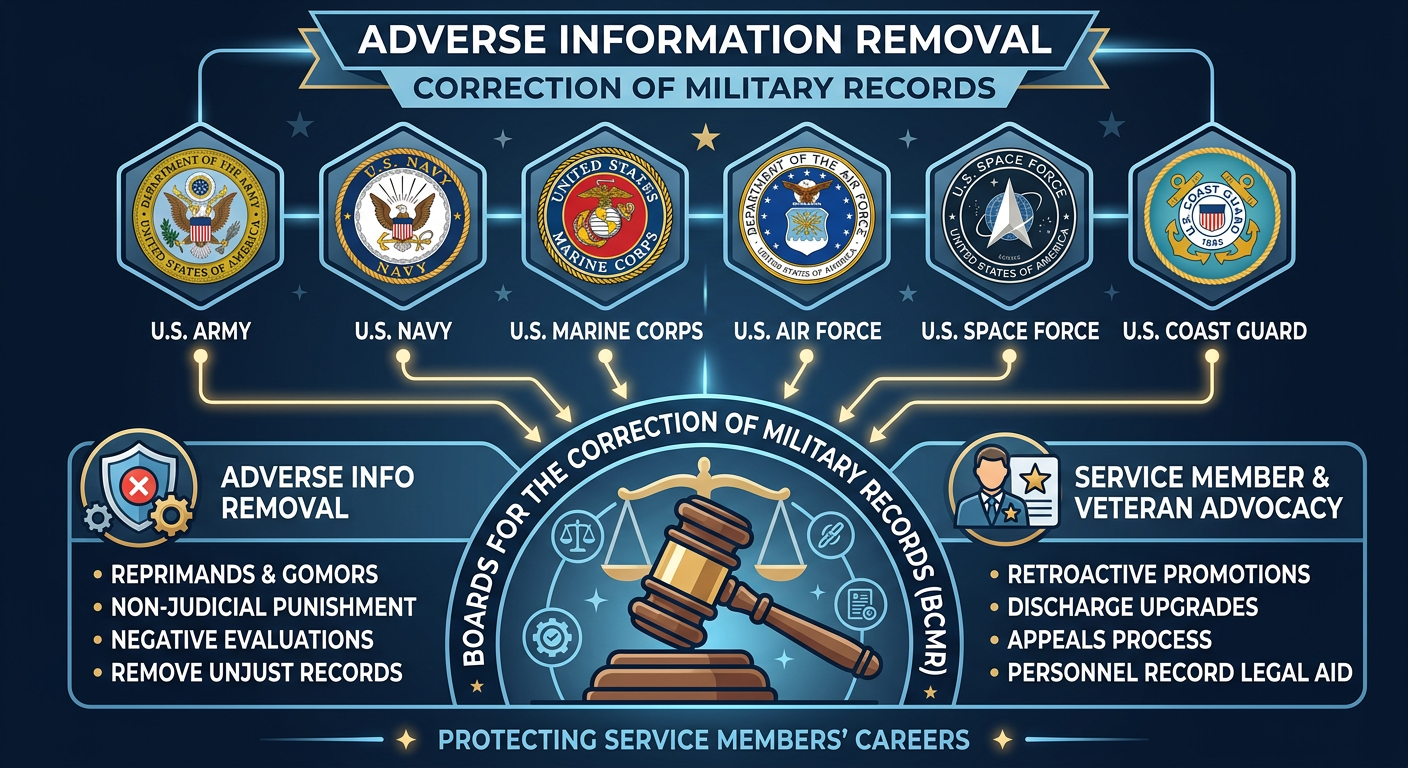
Active-Duty Boards, BCMR & Special Selection Boards
A single piece of “bad paper” in your Official Military Personnel File (OMPF / AMHRR)—such as a General Officer Memorandum of Reprimand (GOMOR), Letter of Reprimand (LoR), referred OER/NCOER/FITREP, or Article 15—can quietly end a promising career. Even when your day-to-day performance is exemplary, promotion boards, command selection boards, and Qualitative Management Program (QMP) panels routinely screen out service members carrying derogatory entries in their viewable performance folder.
At the Law Office of Peter Kageleiry, Jr., LLC, we represent active-duty service members, Reservists, National Guard personnel, and veterans worldwide in challenging, removing, and transferring adverse administrative records—and pursuing Special Selection Boards (SSBs) when unfair records have already caused a promotion pass-over.
Why Timing & Forum Selection Matter
In military administrative law, you cannot usually jump straight to a federal correction board. Federal law and DoD regulations require service members to exhaust administrative remedies through active-duty intermediate boards before petitioning a Board for Correction of Military Records (BCMR). Selecting the right forum—and building an airtight evidentiary record on the first submission—is critical because a denial can itself become part of your permanent record.
Stage 1: Active-Duty Intermediate Boards (Removing or Shielding Bad Paper Before a Board Convenes)
When you are still serving on active duty—especially when a promotion zone or command screen is 9 to 18 months away—we target your branch’s intermediate review boards to clear your viewable file before a selection board sees it:
-
Suitability & Unfavorable Information Boards (e.g., Army DASEB): Under regulations such as AR 600-37, the Department of the Army Suitability Evaluation Board (DASEB) adjudicates requests to remove or transfer permanently filed reprimands and Article 15s. We pursue one of two distinct remedies depending on the facts of your case:
-
Full Removal (Expungement): Available at any time if we establish by clear and convincing evidence that the adverse document is factually untrue, unsupported, or unjust.
-
Transfer to the Restricted Folder: Once you have received at least one evaluation report since the reprimand, we can petition to move an accurate reprimand out of your viewable performance folder and into the restricted portion of your AMHRR—shielding it from routine promotion and command selection boards—by proving it has served its intended purpose and transfer is in the best interest of the service.
-
-
Service-Level Evaluation Appeal Boards: Referred OERs, NCOERs, and FITREPs cannot simply be deleted through a general reprimand request; they must be challenged through dedicated evaluation appeal channels (such as the Army Special Review Board [ASRB], the Air Force Evaluation Reports Appeal Board [ERAB], or Navy/Marine Corps fitness report review channels). We build comprehensive packets proving substantive inaccuracy, procedural violations, rater bias, or lack of objectivity.
-
Command & Imposing Authority Support: Wherever possible, we work alongside your current chain of command—and petition the original imposing authority—to obtain formal endorsements supporting removal, transfer, or evaluation amendment.
Stage 2: Boards for Correction of Military Records (BCMR)
When an active-duty intermediate board denies relief, when an issue falls outside intermediate board jurisdiction, or after you have separated from service, we escalate your case to your service’s highest administrative appellate body under 10 U.S.C. § 1552:
-
Army Board for Correction of Military Records (ABCMR)
-
Board for Correction of Naval Records (BCNR) (Navy & Marine Corps)
-
Air Force Board for Correction of Military Records (AFBCMR) (Air Force & Space Force)
-
Coast Guard Board for Correction of Military Records (BCM)
Unlike intermediate panels bound strictly by narrow technical rules, a BCMR holds broad statutory and equitable authority to correct any military record when necessary to correct an error or remove an injustice. We prepare formal legal briefs supported by sworn affidavits, digital and documentary evidence, regulatory analyses, and post-incident performance records to persuade the board to expunge unjust reprimands, void defective evaluations, set aside non-judicial punishment, and clear related investigative flags.
Stage 3: Special Selection Boards (SSBs) — Fixing an Unfair Promotion Pass-Over
Removing a piece of bad paper is only half the battle if that unfair document already caused you to be passed over for promotion. Under 10 U.S.C. § 628 (for active-duty officers) and 10 U.S.C. § 14502 (for Reserve officers)—alongside parallel enlisted standby advisory board procedures—service members who were non-selected due to a material error or injustice in their record can petition for reconsideration by a Special Selection Board (SSB).
How We Connect Record Correction to an SSB
-
Establishing Material Error or Injustice: Simply having a minor typo in your file is not enough for an SSB. We demonstrate that the record reviewed by your original promotion board contained a materially unfair document (such as an unsubstantiated GOMOR, a defective referred OER/FITREP, or an unjust Article 15) or omitted critical favorable evaluations/awards that should have been in your file.
-
Reconstructing Your Corrected File: Once the BCMR or active-duty appeal board removes or amends the defective record, your corrected personnel file is placed before a specially convened SSB.
-
Judging Against Original Board Standards: The SSB evaluates your corrected record alongside benchmark files from your original promotion board—ensuring you are judged fairly as if the bad paper had never been there.
-
Back Pay, Date of Rank & Career Restoration: If the SSB selects you for promotion, your date of rank, seniority, and pay are adjusted retroactively to match the original board—and if you were involuntarily separated or retired due to a two-time non-selection, we pursue reinstatement or retirement grade adjustments.
Comparison: Active-Duty Boards vs. BCMR vs. Special Selection Boards
| Feature | Active-Duty Intermediate Boards (e.g., DASEB, ASRB, ERAB) | Board for Correction of Military Records (BCMR) | Special Selection Board (SSB) |
| Primary Purpose | Remove or restrict adverse reprimands and appeal defective evaluations while serving. | Broad statutory review to correct errors or remove injustices across any military record. | Reconsider a service member for promotion after a material error or injustice is fixed. |
| Governing Authority | Service-specific regulations (e.g., AR 600-37, AR 623-3, DAFI 36-2406). | 10 U.S.C. § 1552 | 10 U.S.C. § 628 (Active) / 10 U.S.C. § 14502 (Reserve) & service enlisted policies |
| Eligibility | Generally active-duty / currently serving members (must exhaust before BCMR). | Active-duty, Reserve, National Guard, and separated veterans. | Service members passed over by a selection board whose record contained a material error. |
| Key Remedies | Full removal (expungement), transfer to restricted folder, or evaluation amendment. | Full expungement, voiding NJP/separations, record amendments, and directing an SSB. | Retroactive promotion selection, adjusted date of rank, back pay, and reversal of pass-overs. |
Contact the Law Office of Peter Kageleiry, Jr., LLC today at +1-757-504-2815 to schedule a confidential consultation and put a proven military advocate in your corner.
Frequently Asked Questions: Removing Adverse Paper & Special Selection Boards
1. How far ahead of my promotion board should I start trying to remove bad paper?
At least 9 to 12 months before your promotion board convenes. Active-duty intermediate boards like the DASEB or service evaluation appeal panels frequently take 4 to 8 months to adjudicate a packet. Starting early gives us time to gather supporting witness statements, obtain command endorsements, and clear your viewable performance file before your board snapshot date closes.
2. What is the difference between removing a GOMOR and transferring it to the restricted folder?
Removal (expungement) permanently deletes the reprimand from your official personnel file altogether, but it requires proving by clear and convincing evidence that the document is untrue or unjust. Transfer to the restricted folder leaves the document in a restricted section of your archive (visible only to specific senior officials or selection boards under special authorization) while removing it from the viewable performance folder seen by routine promotion and command boards. Transfer is often the strongest strategic option when the underlying facts are undisputed, you have demonstrated strong rehabilitation through subsequent evaluations, and enough time has passed for the reprimand to have served its purpose.
3. Do I have to apply to an active-duty board before going to the BCMR?
In most cases, yes. Under federal exhaustion-of-remedies rules, the ABCMR, BCNR, AFBCMR, and Coast Guard BCM will routinely return an application without action if you have not first petitioned the appropriate active-duty intermediate board (such as the DASEB or a service evaluation appeal board). Our firm maps out the exact sequence of filings so your petition is never rejected on procedural grounds.
4. If the BCMR removes a bad evaluation or reprimand after I was passed over, do I automatically get promoted?
No—removing the record earns you reconsideration, not an automatic promotion. Once the BCMR expunges the unjust document, we request referral to a Special Selection Board (SSB) (or enlisted standby advisory board). The SSB reviews your newly cleaned record against the actual selection standards of the board that passed you over. If the SSB selects you, your promotion, back pay, and date of rank are restored retroactively.
5. Can I request a Special Selection Board if I did not exercise due diligence before my original promotion board?
Usually no—and this is a critical trap. Under 10 U.S.C. § 628, an SSB can be denied if the board determines that you failed to exercise reasonable diligence in discovering and correcting an obvious error in your record before your original promotion board met (for example, failing to review your board file when a missing award or obvious administrative mistake was visible). However, when an unfair reprimand, defective evaluation, or pending appeal could not reasonably be resolved before the board convened, we build the legal record demonstrating full diligence to protect your right to SSB relief.
Protect Your Career & Promotion Eligibility
Whether you are trying to scrub an unfair reprimand or evaluation before your next promotion board, or fighting to overturn an unjust pass-over through the BCMR and a Special Selection Board, you need a deliberate, evidence-backed strategy. Contact the Law Office of Peter Kageleiry, Jr., LLC today for a confidential review of your military personnel file and promotion history.