

When does the military use a Board of Inquiry?
The military uses Boards of Inquiry (BOIs)—frequently referred to as Show Cause Boards—to evaluate whether an officer should be retained in the military. These boards consider a wide range of misconduct, performance issues, or suitability concerns that call into question an officer’s fitness for continued service.
While the specific triggers for a BOI vary by branch, common reasons include unprofessional conduct, negligence, ethical violations, security clearance issues, and substance abuse.
What is an Officer Show Cause Board, and how do I win it?
An Officer Show Cause Board is an administrative hearing where the government “notifies” an officer that they must “show cause” as to why they should be allowed to remain on active duty. Essentially, the burden shifts to the officer to prove their value to the service in the face of alleged misconduct or sub-standard performance.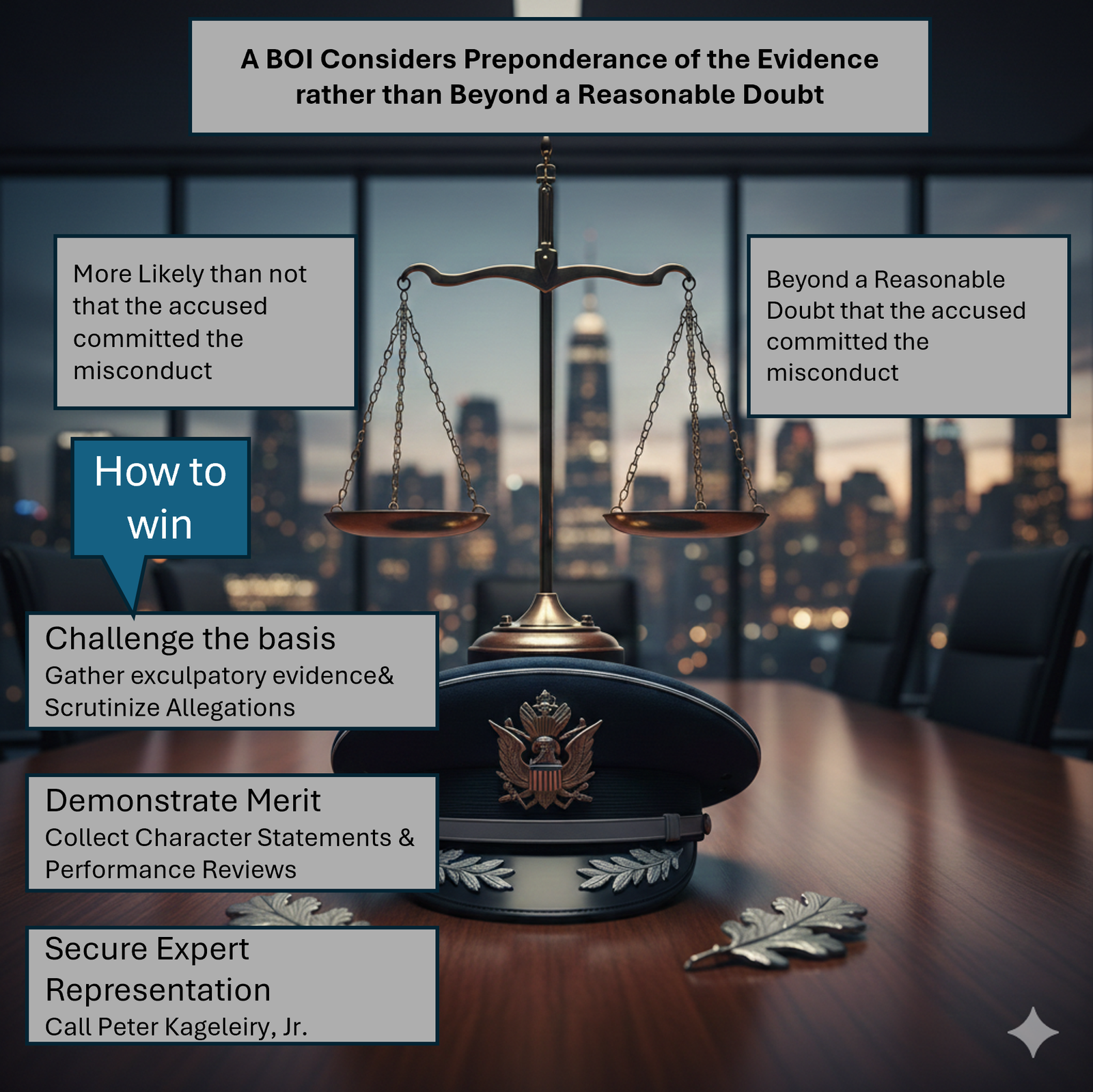
How to Win a Show Cause Board
Winning a BOI means securing a recommendation for retention. To achieve this, your defense must focus on three primary objectives:
Challenging the Basis: We first work to prove that the alleged misconduct did not occur or that the government’s evidence—often based on a “preponderance of the evidence” (more likely than not) standard—is insufficient.
Demonstrating Merit: We present a robust “case in extenuation and mitigation.” This involves gathering character statements, performance evaluations, and evidence of a stellar career to show that the incident in question is an outlier.
Expert Representation: You win by having an experienced counsel who knows how to cross-examine government witnesses and present a compelling narrative to the senior officers sitting on the board.
Common Issues Addressed by a BOI
Unprofessional Conduct: Disrespect, failure to follow orders, or breaches of discipline.
Negligence or Incompetence: Mishandling equipment or failures in leadership.
Ethical Violations: Conflicts of interest or misuse of government resources.
Sexual Harassment or Discrimination: Military policies now frequently mandate involuntary separation for those found to have committed sexual harassment.
Criminal Conduct: Even if a case doesn’t result in a court-martial, the military may use a BOI to address conduct that raises concerns about fitness for service.
Why a Board of Inquiry instead of a Court-Martial?
The military often prefers BOIs for non-criminal matters or cases where they want a faster, more efficient administrative resolution.
Lesser Standard of Proof: Unlike a court-martial, which requires proof “beyond a reasonable doubt,” a BOI only requires a “preponderance of the evidence.”
Administrative Focus: The goal isn’t jail time; it’s determining whether the officer should keep their job and their commission.
Threats to an Officer’s Career
A BOI is not a “minor” event. It poses several severe threats:
Involuntary Separation: The most common outcome of a failed BOI is a discharge, which can be Honorable or General (Under Honorable Conditions).
Loss of Benefits: A General discharge can lead to the loss of GI Bill benefits and significantly impact future civilian employment.
Reputational Damage: Even if you are retained, the record of a BOI can effectively end your chances of future promotion.
Protect Your Commission
Many Boards of Inquiry are winnable with expert representation and proper evidence. If you have been “notified” or believe an investigation is heading toward a Show Cause Board, do not wait. Your career and your retirement are on the line.
Contact The Law Office of Peter Kageleiry, Jr. today at 757-504-2815 cor contact us to begin building your defense.


