A plain-language guide for service members, families, and anyone seeking to understand military sexual assault law.
What is UCMJ Article 120?
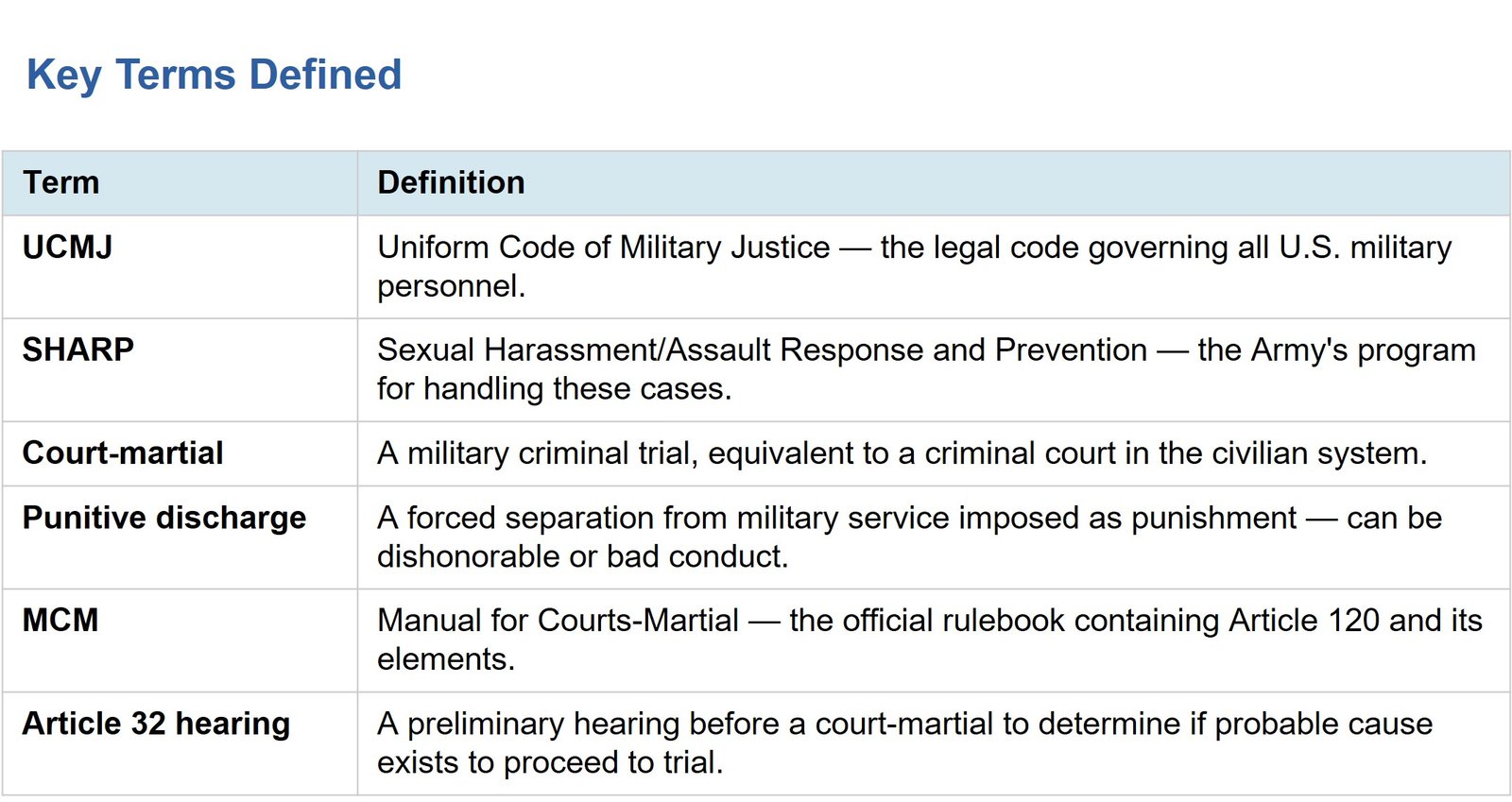
Article 120 of the Uniform Code of Military Justice (UCMJ) is the federal law that governs rape, sexual assault, and related sexual offenses committed by members of the U.S. Armed Forces. It applies to active-duty personnel, reservists, and National Guard members when they are subject to military jurisdiction.
Unlike civilian law, which varies by state, Article 120 creates a single national standard for how sexual offenses are defined and prosecuted within the military.
 How Has the Law Changed Over Time?
Before 2007
Prosecutors were required to prove that sex occurred “without the consent” of the alleged victim. The law was relatively brief and straightforward.
2007
Congress rewrote Article 120 and removed the consent element. The new version had significant legal problems and was widely criticized as unworkable.
2012
The 2007 version was repealed and replaced. The revised law expanded the offenses covered and grew from half a page to two full pages in the MCM, plus eleven pages of discussion.
2019 — present
Further updates were made. Prosecutors can now charge a single incident under multiple provisions simultaneously, increasing the likelihood of at least one conviction.
2022 — NDAA
Although there aren’t specific changes in the law regarding Article 120 itself, the NDAA 2022 did change how Article 120 would be prosecuted. As noted in a Lawfare article, NDAA 2022 determined how much discretionary court-martial disciplinary authority would be removed from commanders. This resulted in the creation of the Office of Special Trial Counsel (OSTC) which has the first bite at the apple in deciding whether allegations should go to trial. If OSTC declines to prosecute, then Commanders have to decide what actions to take short of a court-martial. Commander’s or HRC could decide to initiate separation, a GOMOR, NJP or take no action if the allegations weren’t founded.
What Does Article 120 Prohibit?
Article 120 defines two main categories of offenses: rape and sexual assault. Each covers several different types of conduct.
Rape
Rape is defined as committing a sexual act upon another person by one or more of the following means:
- Using unlawful physical force.
- Using force likely to cause death or serious bodily harm.
- Threatening the victim with death, grievous bodily harm, or kidnapping.
- Rendering the victim unconscious before the act.
- Administering a drug, intoxicant, or similar substance without the victim’s knowledge or consent.
Sexual Assault
Sexual assault involves committing a sexual act under circumstances that make consent absent or impossible — for example, when a person is asleep, incapacitated, or has been misled about the identity of the person they are with.
Important: The full list of elements under current Article 120 is extensive. Prosecutors often charge one incident under multiple provisions at once. For the complete statutory language, consult the 2019 Manual for Courts-Martial or speak with a qualified military attorney.
What Are the Consequences of a Conviction?
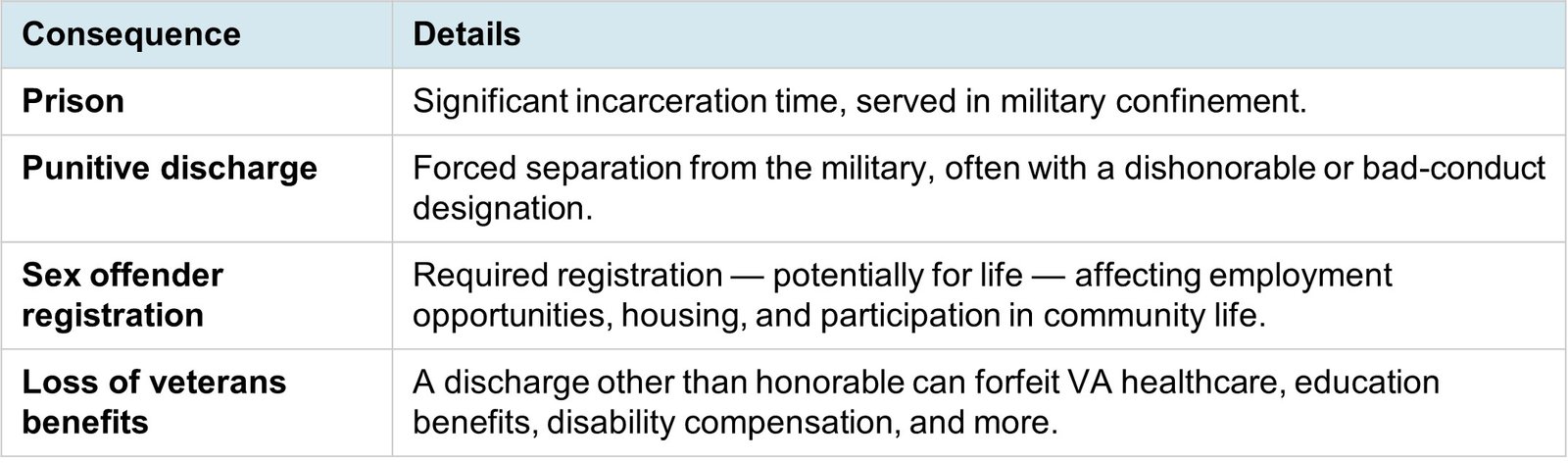
A conviction under Article 120 can have severe and lasting consequences, including:
Contact The Law Office of Peter Kageleiry, Jr.
No matter where you are stationed in the world, contact my office +(757) 504-2815 or through our convenient online form to schedule a consultation.
Attorney Peter Kageleiry, Jr., focuses his legal practice exclusively on military court-martial law and related adverse administrative actions.
Frequently Asked Questions: UCMJ Article 120 (Rape & Sexual Assault)
1. What is UCMJ Article 120?
2. How does Article 120 define Rape vs. Sexual Assault?
- Rape: Committing a sexual act through unlawful physical force, force likely to cause death or grievous bodily harm, threats of death/kidnapping, rendering a victim unconscious, or administering an intoxicant without knowledge/consent.
- Sexual Assault: Committing a sexual act under conditions where consent is absent or legally impossible, such as when a person is sleeping, incapacitated, or deceived about the identity of the person they are with.
3. Why are prosecutors charging single incidents under multiple provisions?
4. Who decides whether an Article 120 allegation goes to a court-martial?
- If the OSTC decides to prosecute, the case proceeds toward a court-martial.
- If the OSTC declines prosecution, the commander regains authority to take alternative measures (such as administrative separation, a GOMOR, Non-Judicial Punishment/NJP, or taking no action).
5. What are the potential penalties if convicted under Article 120?
- Confinement in military prison (up to life depending on charges).
- Punitive discharge (Dishonorable Discharge, Bad Conduct Discharge, or Dismissal for officers).
- Total forfeiture of pay and allowances, plus reduction in rank.
- Mandatory lifetime sex offender registration under state and federal registries.
6. What non-judicial actions can happen if formal court-martial charges are declined?
- Administrative Separation Boards / Show Cause Boards: Mandatory processing to involuntarily discharge the service member.
- GOMOR / Letters of Reprimand: Written administrative reprimands placed permanently into the service member’s official record.
- Non-Judicial Punishment (NJP / Article 15): Administrative discipline imposing forfeitures, extra duty, or restriction.
7. When should I retain a dedicated Article 120 defense lawyer?
Defending Your Freedom
If you are a soldier, sailor, airman, or Marine facing a military court-martial or
if you are under investigation put Peter Kageleiry to work in your military defense.
Your military career, your service record and your future depend on it.
Contact Us or Call for a free consultation: (757) 504-2815