Reclaim Your Honor. Unlock Your Earned Benefits
A less-than-honorable discharge can follow you for life—blocking VA healthcare, GI Bill benefits, and civilian career opportunities. Our experienced military defense attorneys build compelling, evidence-backed petitions to upgrade your discharge characterization and restore the honor you earned.
UNDERSTANDING THE TWO-TIER DISCHARGE UPGRADE SYSTEM
How the Military Discharge Upgrade Process Works
Upgrading a military discharge requires proving to a military review board that your discharge was either improper (an error of law, procedure, or policy occurred) or inequitable (the discharge was overly harsh or inconsistent with current military standards, including mitigating factors like PTSD, Traumatic Brain Injury, Military Sexual Trauma, or mental health conditions). The board you apply to depends primarily on how long ago you were discharged and the type of discharge you received.
Tier 1: Discharge Review Board (DRB) — DD Form 293
-
Eligibility Window: Within 15 years of your date of separation.
-
Scope of Authority: Can upgrade your characterization of service (e.g., General Under Honorable Conditions, Other Than Honorable [OTH], or Bad Conduct Discharge from a Special Court-Martial) and change your Narrative Reason for Separation and Reentry (RE) Code.
-
Limitations: Cannot overturn a General Court-Martial punitive discharge or grant medical retirement.
-
Review Options: Documentary (records) review or a personal appearance hearing.
Tier 2: Board for Correction of Military/Naval Records (BCMR / BCNR) — DD Form 149
-
Eligibility Window: More than 15 years after discharge, or if you have already been denied by a Discharge Review Board.
-
Scope of Authority: Broadest statutory authority under 10 U.S.C. § 1552. Can upgrade General Court-Martial discharges (on clemency grounds), correct factual errors in military records, and convert administrative discharges to medical retirements.
-
Review Format: Primarily conducted via written record review (in-person hearings are rare and granted only at the board’s discretion).
THE 5-STEP UPGRADE ROADMAP
Five Steps to Building a Winning Petition
-
Obtain Your Complete Service & Medical Records
Request your Official Military Personnel File (OMPF), DD-214, separation packet, and both Service Treatment Records (STRs) and VA medical files. You cannot dismantle an unfair discharge without seeing the exact evidence the command relied upon.
-
Identify Legal Errors or Mitigating Factors
Pinpoint procedural violations during separation proceedings, or establish nexus evidence linking misconduct to undiagnosed PTSD, TBI, Military Sexual Trauma (MST), mental health conditions, or discriminatory policies.
-
Gather Corroborating & Post-Service Evidence
Compile independent psychological evaluations, buddy statements from fellow service members, character references from employers and community leaders, and proof of post-service rehabilitation.
-
Draft a Persuasive Legal Brief
Review boards operate under the Presumption of Regularity—meaning they assume the military acted properly unless proven otherwise. A structured legal brief maps your evidence directly to DoD Liberal Consideration standards and governing service regulations.
-
Submit Your Petition & Prepare for Your Hearing
File DD Form 293 or DD Form 149 with the appropriate service board. If eligible for a personal appearance before a DRB, prepare testimony and legal arguments with counsel to answer board member questions directly.
PROCESS DELINEATION BY SERVICE BRANCH
Discharge Upgrade Procedures by Military Branch
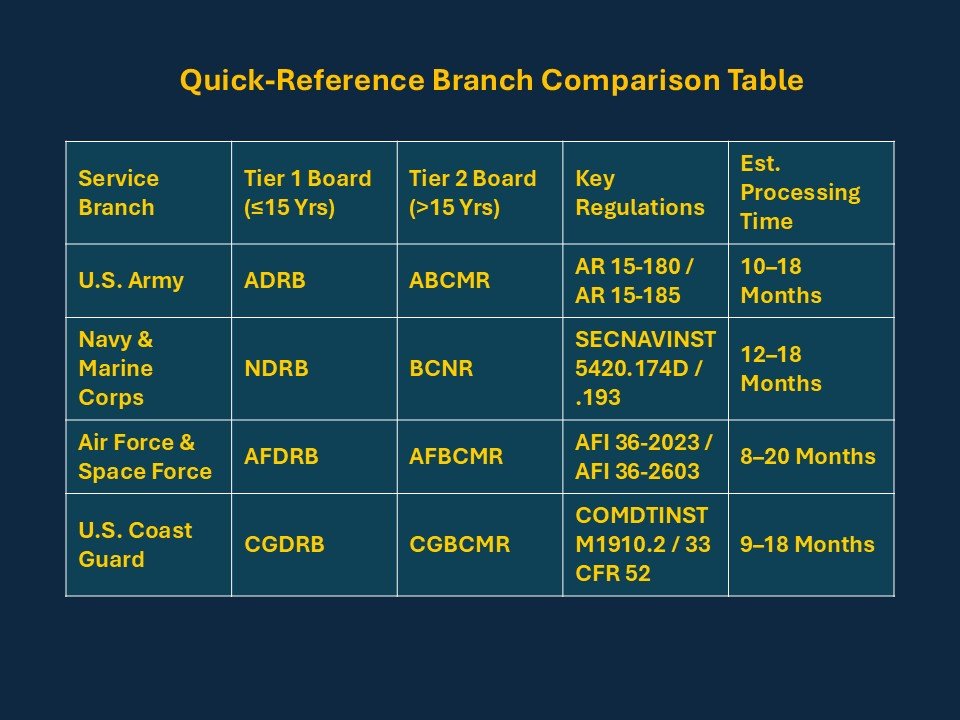
While every branch follows Department of Defense (DoD) overarching directives, each military department operates its own review boards with distinct mailing/portal submission systems, governing regulations, and processing timelines.
1. U.S. Army
-
Review Boards: Army Discharge Review Board (ADRB) & Army Board for Correction of Military Records (ABCMR)
-
Headquarters / Location: Army Review Boards Agency (ARBA), Arlington, Virginia
-
Governing Regulations: AR 15-180 (ADRB) | AR 15-185 (ABCMR)
-
Hearing Options: In-person hearings in Arlington, VA, Video Teleconference (VTC) hearings, or documentary record review.
-
Estimated Timeline: 10 to 14 months (ADRB); 12 to 18 months (ABCMR).
-
Branch-Specific Nuances: The Army utilizes the ARBA online portal for electronic submissions. ADRB allows applicants to request a documentary review first and, if denied, request a subsequent personal appearance hearing (provided it is still within the 15-year window).
2. U.S. Navy & U.S. Marine Corps
-
Review Boards: Naval Discharge Review Board (NDRB) & Board for Correction of Naval Records (BCNR)
-
Headquarters / Location: Washington Navy Yard, Washington, D.C.
-
Governing Regulations: SECNAVINST 5420.174D (NDRB) | SECNAVINST 5420.193 (BCNR)
-
Hearing Options: Personal appearance hearings in Washington, D.C., Video Teleconference (VTC), or documentary review. (Note: Traveling boards are largely replaced by VTC).
-
Estimated Timeline: 12 to 16 months (NDRB); 14 to 18 months (BCNR).
-
Branch-Specific Nuances: Both Sailors and Marines apply to the same Department of the Navy boards. Because Marine Corps standards of conduct and administrative separation boards carry strict evidentiary rules, petitions must directly address Marine Corps Separation and Retirement Manual (MARCORSEPMAN) procedures alongside Naval BUPERS rules.
3. U.S. Air Force & U.S. Space Force
-
Review Boards: Air Force Discharge Review Board (AFDRB) & Air Force Board for Correction of Military Records (AFBCMR)
-
Headquarters / Location: Joint Base Andrews, Maryland
-
Governing Regulations: AFI 36-2023 (AFDRB) | AFI 36-2603 (AFBCMR)
-
Hearing Options: Personal appearance hearings at Joint Base Andrews, MD, virtual VTC hearings, or documentary record review.
-
Estimated Timeline: 8 to 14 months (AFDRB); 12 to 20 months (AFBCMR).
-
Branch-Specific Nuances: Space Force Guardians are adjudicated by the Department of the Air Force boards. The AFDRB places heavy emphasis on advisory opinions from Air Force mental health consultants when PTSD, TBI, or MST is raised, making pre-submission independent clinical evaluations critical.
4. U.S. Coast Guard
-
Review Boards: Coast Guard Discharge Review Board (CGDRB) & Coast Guard Board for Correction of Military Records (CGBCMR)
-
Headquarters / Location: U.S. Coast Guard Headquarters / Office of the General Counsel (Department of Homeland Security), Washington, D.C.
-
Governing Regulations: COMDTINST M1910.2 (CGDRB) | 33 CFR Part 52 (CGBCMR)
-
Hearing Options: Personal appearance hearings in Washington, D.C., telephonic/video appearances, or documentary review.
-
Estimated Timeline: 9 to 15 months (CGDRB); 12 to 18 months (CGBCMR).
-
Branch-Specific Nuances: Unlike the DoD branches, the Coast Guard operates under the Department of Homeland Security (DHS) during peacetime. While DHS has adopted DoD Liberal Consideration principles for mental health and MST claims, CGBCMR petitions are adjudicated by civilian attorneys within the DHS Office of the General Counsel.
WHY WORK WITH A MILITARY DISCHARGE UPGRADE LAWYER?
Don’t Leave Your Future to Chance—Put a Military Lawyer in Your Corner
Most self-filed discharge upgrade applications are denied because veterans submit personal letters instead of legally actionable evidence.
By law, military review boards begin every case with the Presumption of Regularity—assuming your former command followed every rule and issued a fair discharge. Overcoming that presumption requires more than telling your side of the story. Overcoming presumption requires building a formal legal record that leaves the board no choice but to grant relief.
How Our Military Defense Attorneys Fight for You:
-
Deep Audit of Your OMPF & Separation Packet: We uncover hidden procedural errors, improper command influence, or due process violations you may never have known occurred.
-
Strategic Application of DoD Liberal Consideration: We frame PTSD, TBI, Military Sexual Trauma (MST), and mental health diagnoses under the Hagel, Kurta, and Wilkie Memoranda to show how your condition mitigated the alleged misconduct.
-
Expert Medical & Psychological Coordination: We work alongside independent clinicians to ensure nexus letters meet the exact evidentiary standards required by board advisory doctors.
-
Direct Representation at Personal Appearance Hearings: We prepare you for every question and present oral arguments directly to the board panel on your behalf.
Contact Us or Call for a consultation
No matter where you are stationed in the world, contact my office at +(757) 504-2815 or through our convenient online form to schedule a consultation. Attorney Peter Kageleiry, Jr., focuses his legal practice exclusively on military court-martial law and related adverse administrative actions.
FREQUENTLY ASKED QUESTIONS (FAQs)
Frequently Asked Questions About Military Discharge Upgrades
Q1: Can my discharge be downgraded if I apply for an upgrade?
A: No. Neither the Discharge Review Boards (DRB) nor the Boards for Correction of Military/Naval Records (BCMR/BCNR) have the authority to downgrade your discharge characterization or make your separation status worse. The worst outcome of an application is that your current discharge remains unchanged.
Q2: What is DoD “Liberal Consideration,” and how does it help my case?
A: Under DoD policy guidance (including the Hagel, Kurta, and Wilkie Memoranda), review boards must give “liberal consideration” to veterans whose misconduct or discharge was linked to PTSD, Traumatic Brain Injury (TBI), Military Sexual Trauma (MST), or other mental health conditions. Even if your condition was never diagnosed while you were on active duty, post-service medical evidence showing that the condition existed during service and mitigated your behavior can weigh heavily in favor of an upgrade.
Q3: How long does the discharge upgrade process take?
A: Processing times vary by branch and whether you request a records review or a personal appearance hearing. On average, Discharge Review Board (DD Form 293) decisions take 8 to 16 months, while Boards for Correction of Military/Naval Records (DD Form 149) take 12 to 20 months. Complex cases requiring advisory medical opinions may take slightly longer.
Q4: Should I request a Documentary Review or a Personal Appearance Hearing?
A: If you are within 15 years of discharge and applying to a DRB, you can often request a documentary review first; if denied, you still retain the right to request a personal appearance hearing (in-person or via Video Teleconference). Personal appearance hearings consistently yield higher approval rates because they allow you and your attorney to answer board members’ questions directly and humanize your service record.
Q5: What is the difference between a VA Character of Discharge (COD) review and a Military Discharge Upgrade?
A: A VA Character of Discharge determination is conducted solely by the Department of Veterans Affairs to decide whether you are eligible for VA healthcare and disability compensation despite an Other Than Honorable (OTH) discharge—it does not change your DD-214. A military discharge upgrade through a DRB or BCMR/BCNR permanently changes your official military records and issues a new DD-215 or corrected DD-214.
Q6: Can I upgrade a Bad Conduct Discharge (BCD) or Dishonorable Discharge from a Court-Martial?
A: Yes, though the rules are stricter. A Discharge Review Board can only upgrade a Bad Conduct Discharge issued by a Special Court-Martial—and only on clemency grounds. If your BCD or Dishonorable Discharge came from a General Court-Martial, you must apply to your branch’s Board for Correction of Military/Naval Records (DD Form 149), which can grant an upgrade strictly as an act of clemency based on post-service conduct and mitigating evidence.
Q7: What if I was discharged under “Don’t Ask, Don’t Tell” (DADT) or for refusing the COVID-19 vaccine?
A: Both categories have dedicated relief pathways. Veterans discharged under DADT or prior policies due to sexual orientation or gender identity are eligible for streamlined upgrades to Honorable, along with removal of discriminatory narrative reasons and RE codes. Similarly, service members separated solely for refusing the rescinded COVID-19 vaccine mandate have specific grounds to petition for discharge upgrades and record corrections.
Q8: What happens if my discharge upgrade application is denied?
A: A denial is not necessarily the end of the road. If a Discharge Review Board denies a documentary review, you can request a personal appearance hearing. If a DRB denies your personal appearance, you can appeal to your branch’s BCMR/BCNR. If a BCMR/BCNR denies your petition, you can submit a request for reconsideration with new and material evidence, or challenge an arbitrary and capricious board decision in federal court under the Administrative Procedure Act (APA).